What Lidar Building Scanning Services Solve
A renovation can go off track before design even starts. One missed beam depth, one undocumented floor slope, or one ceiling cavity packed with unrecorded systems can force redesign, delay permits, and create change orders that should have been avoidable. That is why lidar building scanning services have become a practical starting point for owners, developers, and project teams who need reliable existing-condition data before making major decisions.
For architecture and development work, the value is straightforward. Better information at the front end leads to better coordination, more realistic budgeting, and fewer surprises once a project moves into documentation or construction. When an existing building is part of the equation, accuracy is not a luxury. It is a control measure.
Why lidar building scanning services matter early
Traditional field measurement still has a place, but it has limits. Manual methods depend on selective measurement, site access, and the assumption that the conditions you can see are the conditions that matter. In older buildings, tenant-occupied properties, adaptive reuse projects, and spaces with years of undocumented modifications, that assumption often fails.
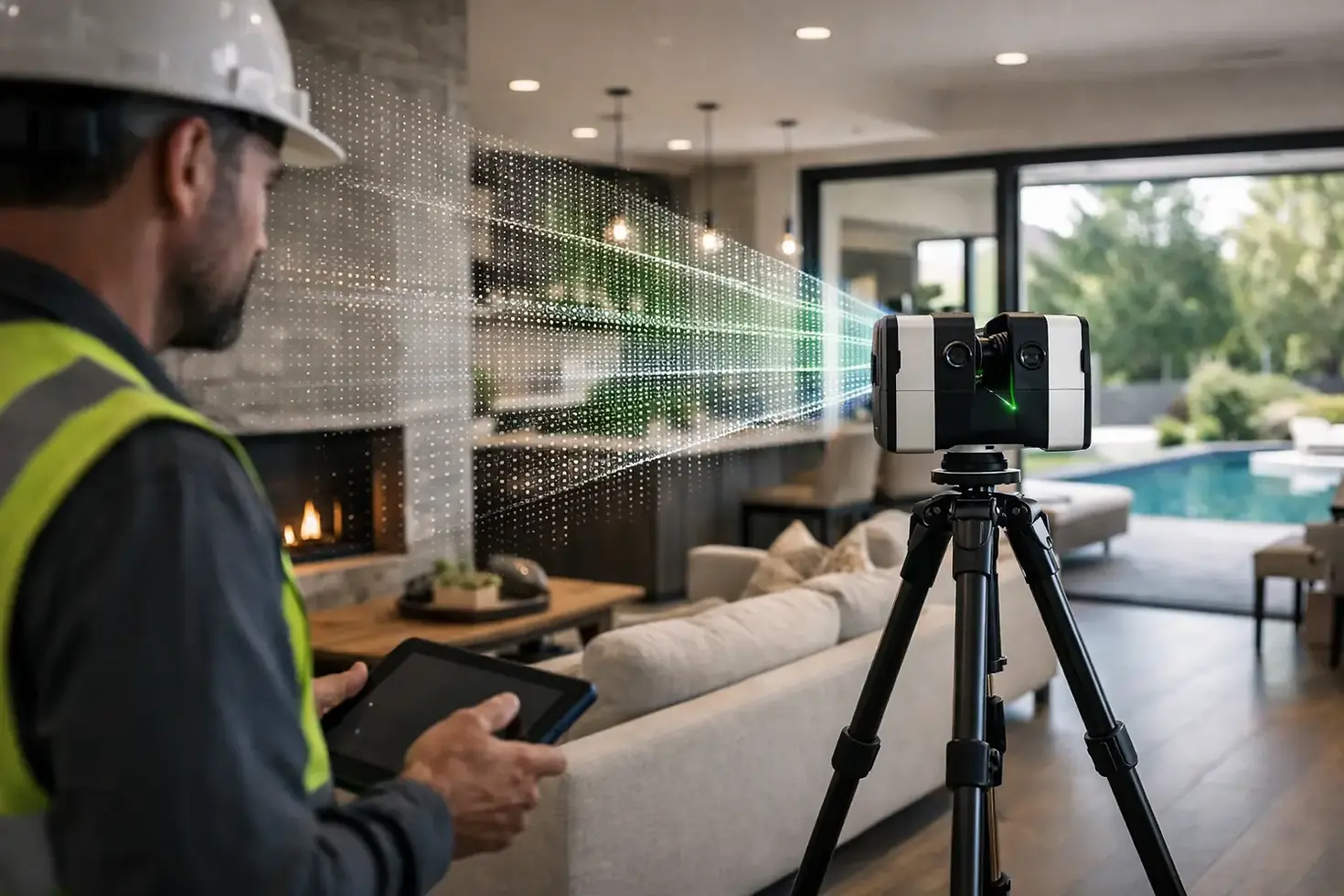
Lidar building scanning services capture dense spatial information across the building rather than relying on a narrow set of tape measurements and hand sketches. The result is a point cloud that records the geometry of the existing environment with a level of completeness that manual surveys rarely match. For an architect, that means walls, floors, ceilings, structural elements, and visible building systems can be referenced with far greater confidence during as-built documentation and design development.
This matters most when a project has little tolerance for error. A tenant improvement with tight MEP coordination, a mixed-use conversion with code-driven constraints, or a residential remodel where every inch affects layout and finish alignment will benefit from accurate baseline data. The earlier that data is captured, the more useful it becomes.
What the service actually delivers
Some clients hear the term scanning and assume the output is simply a visual model. In practice, the deliverable is only valuable if it supports decisions. The scan itself is one step in a broader documentation process.
A properly managed building scan can support as-built floor plans, reflected ceiling plans, elevations, sections, and three-dimensional reference models. It can also improve verification of structural framing, window and door openings, slab conditions, roof geometry, and major mechanical pathways where visible access exists. For owners and developers evaluating an acquisition or repositioning opportunity, that information can sharpen feasibility analysis before the project team invests in full design effort.
There is also a coordination benefit that is easy to underestimate. When consultants are working from the same verified source conditions, there is less room for conflicting assumptions. Structural, MEP, interiors, and architecture teams can align around one existing-condition dataset instead of rebuilding the base information from separate site visits and incomplete notes.
Where lidar building scanning services create the most value
The strongest use cases are not always the largest buildings. They are the projects where uncertainty is expensive.
Adaptive reuse is a clear example. If an older commercial or industrial building is being repositioned, the existing shell may hold irregular dimensions, hidden offsets, nonstandard framing, and additions that do not match archived records. Scanning helps establish what is actually there, which is far more useful than relying on legacy drawings that may no longer reflect field conditions.
Renovations and additions also benefit. When new construction has to tie precisely into existing walls, rooflines, or floor elevations, a small discrepancy can affect waterproofing, structural transitions, and finish continuity. A scan-based as-built process reduces that exposure.
Occupied buildings are another strong fit. In hospitality, retail, office, multifamily, and institutional settings, field access may be limited and repeat visits may disrupt operations. Capturing a broad and accurate record in a shorter window can reduce site friction while giving the design team more complete information back in the office.
For higher-end residential work, the value is often about precision and decision quality. Custom homes and estate renovations tend to involve exacting client expectations, complex geometries, and extensive coordination between architecture, interiors, millwork, and specialty trades. Detailed existing-condition data supports cleaner integration and fewer last-minute adjustments.
What scanning does not solve on its own
It is worth being clear about trade-offs. Scanning is not a substitute for architectural judgment, consultant coordination, or due diligence. It gives the team a stronger factual basis, but it does not interpret code, confirm concealed conditions, or eliminate the need for selective verification.
For example, lidar will not reliably reveal what is hidden behind finished walls. If a project depends on unknown framing, concealed utilities, or undocumented structural alterations, additional investigation may still be necessary. Likewise, if the scan is not processed and translated into usable architectural documentation, the raw data alone will not help an owner make informed project decisions.
This is where service quality matters. The difference between useful scanning and expensive data collection is the ability to turn captured conditions into working documents that support design, entitlement, pricing, and construction coordination.
How architects use scan data in real project workflows
The most effective scanning workflows are integrated into the broader design process rather than treated as a standalone technical exercise. That is especially important for clients who are balancing feasibility, entitlement timing, design quality, and budget pressure at the same time.
At the front end, scan data can support site and building evaluation, helping a team understand constraints before committing to a program or development path. During schematic design, it provides a more reliable framework for testing layouts and interventions within the actual geometry of the building. As the project advances, it improves dimensional control for consultant coordination and construction documentation.
In practical terms, this often means fewer redraws, fewer field clarification requests, and a more credible basis for contractor pricing. It can also improve communication with owners who need to evaluate options based on realistic conditions rather than idealized assumptions.
A firm with both design and development fluency can extract more value from that information. The point is not only to document the building accurately, but to use that accuracy to support better decisions across planning, design, approvals, and construction.
Choosing the right provider for lidar building scanning services
Not all providers approach the work from the same perspective. Some are focused primarily on data capture. Others understand how scan information feeds actual project delivery. For a client, that distinction matters.
If your goal is a construction-ready renovation, consultant coordination, or entitlement support, the provider should understand how architects, developers, and builders use existing-condition information. Accuracy is essential, but so is organization, scope definition, and the ability to convert field data into actionable deliverables.
It is also worth asking what level of documentation is truly needed. A simple tenant improvement may only require targeted as-built drawings. A more complex repositioning or phased redevelopment may justify a deeper scan effort and more developed model outputs. The right scope depends on the project’s risk profile, budget, and the cost of being wrong.
In markets where older building stock, coastal conditions, hillside sites, and layered code requirements shape project outcomes, early clarity has real value. That is one reason firms such as SP-ARC incorporate lidar-based as-built documentation into a broader architectural and development support process rather than treating it as an isolated service.
The business case is really about reducing uncertainty
The strongest argument for scanning is not technology. It is risk management.
When owners move forward with incomplete existing-condition data, they are often carrying hidden costs. Those costs show up as redesign hours, consultant conflicts, permit corrections, construction delays, and field modifications that strain both schedule and budget. Lidar building scanning services help reduce that uncertainty by establishing a more dependable starting point.
That does not mean every project needs the same level of scanning. A small interior refresh may not justify a comprehensive effort. But where geometry is irregular, documentation is outdated, access is limited, or the project budget leaves little room for rework, scan-based documentation is often the more disciplined choice.
The best projects are not defined by how quickly drawings begin. They are defined by how well the team understands existing conditions before critical decisions are locked in. If a building is part of the problem, accurate measurement becomes part of the solution.
For owners and developers, that is the real benefit. Better information at the start creates more control over what happens next.


Comments